
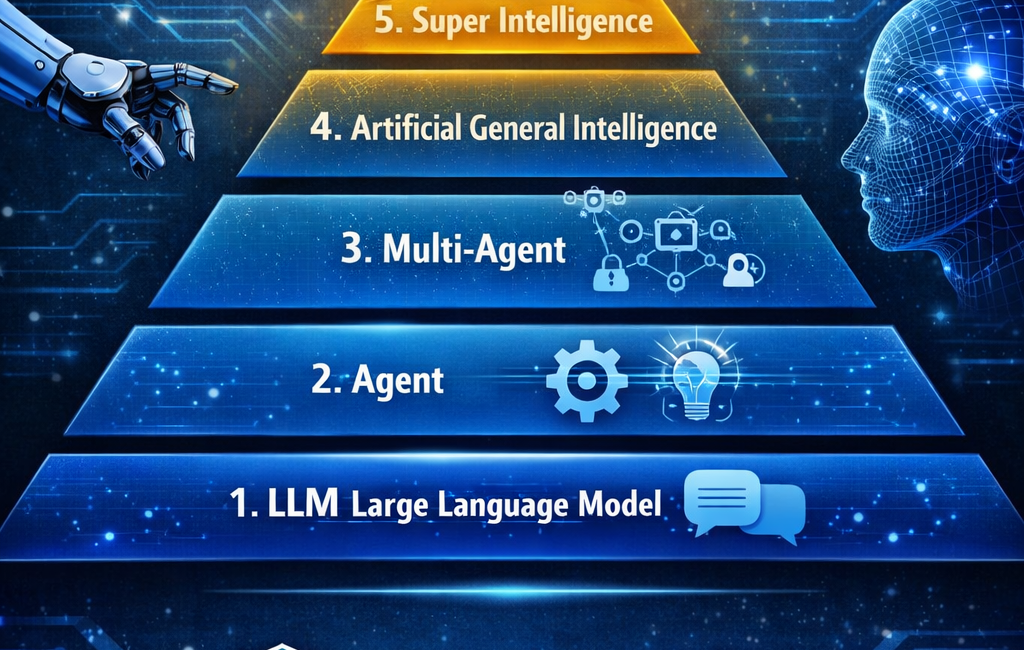
AI in Higher Education: How CIEUNIVERSITY Integrates the 5 Stages of AI Across All Study Programs
Artificial intelligence is transforming higher education, the workplace, and nearly every industry. What was once seen as a topic only for computer science is now relevant to law, real estate, psychology, hospitality, business, healthcare, media, management, and many other disciplines. At CIEUNIVERSITY, we believe that the future of education must reflect the future of work. That is why we integrate the 5 stages of AI across all study programs.
From Large Language Models (LLMs) to AI Agents, Multi-Agent Systems, Artificial General Intelligence (AGI), and Super Intelligence, the development of AI is changing how students learn and how professionals will work in the future. Our goal is not only to teach students about technology, but to prepare them to use AI responsibly, strategically, and confidently in their chosen field.
Whether students study on campus, hybrid, dual, or online, CIEUNIVERSITY is committed to flexible, future-focused education that connects academic excellence with AI innovation.

Why AI Education Matters in All Study Programs
AI is no longer a separate specialist topic. It is becoming part of the foundation of modern professional life. Students entering the workforce today will be expected to understand digital tools, evaluate AI-supported systems, and adapt to intelligent technologies in their industry.
This applies to all fields of study. Law is being shaped by AI-assisted legal research, document analysis, and compliance workflows. Real estate is increasingly influenced by AI-driven market analysis, smart property management, and customer communication. Psychology is evolving through digital mental health tools, AI-supported assessment environments, and new questions about human behavior in a digital world. Hospitality is using AI for guest experience, service personalization, reservations, and operational efficiency. Business and management are seeing AI transform decision-making, automation, analytics, and leadership. Healthcare and service-related fields are working with AI-supported communication, administration, and process improvement. Media and communication are being redefined by content automation, audience analysis, and ethical questions around AI-generated information.
At CIEUNIVERSITY, we believe every student should graduate with a strong understanding of how AI affects their sector. This is why AI in higher education must be integrated into all study programs, not taught as an isolated concept.
The 5 Stages of AI at CIEUNIVERSITY
Understanding the 5 stages of AI helps students see where AI is today, where it is going, and why universities must prepare graduates for this transformation. At CIEUNIVERSITY, these stages are integrated as part of a modern and interdisciplinary educational approach.
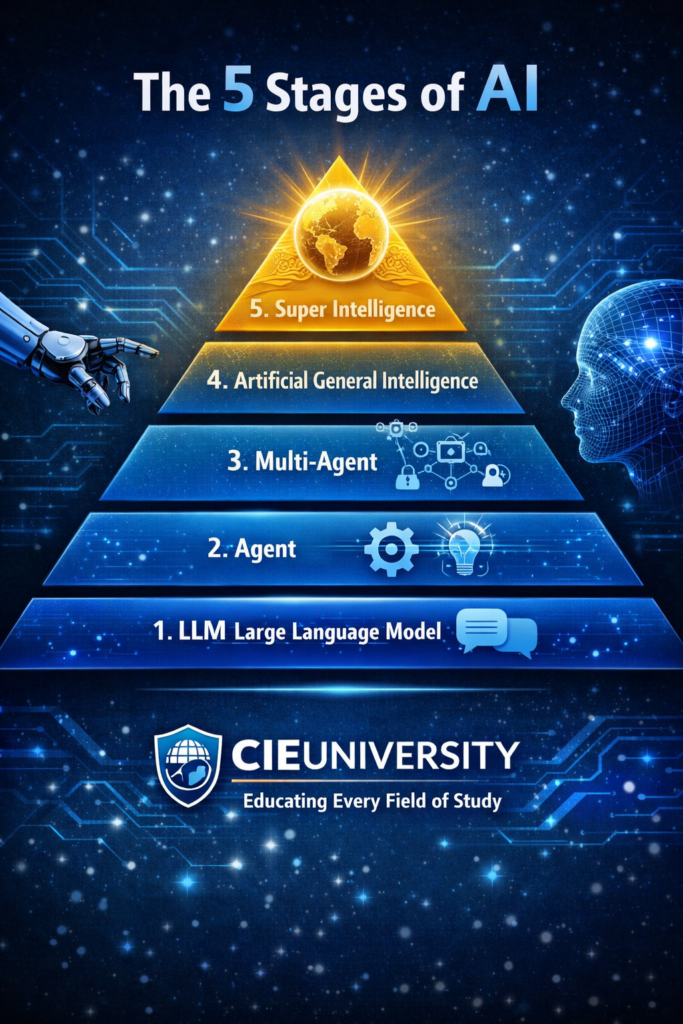
1. Large Language Models (LLMs)
Large Language Models are one of the most visible stages of AI today. These systems can understand and generate human language, making them useful for writing, summarizing, analyzing text, answering questions, and supporting communication.
For students, LLMs are highly relevant in daily academic and professional practice. They are already changing how knowledge is accessed and how information is processed.
Across all study programs, LLMs can play different roles. In law, they can support the review of legal materials, research preparation, and structured writing. In real estate, they can help create property descriptions, market summaries, and communication materials. In psychology, they can assist with research overview, structured documentation, and theoretical comparison. In hospitality, they can improve service communication, multilingual interaction, and customer support processes. In business, they can support strategic writing, reporting, and presentation development. In media, they can enhance content ideation and communication workflows.
At CIEUNIVERSITY, students learn not only how to use LLMs, but how to evaluate them critically, question their outputs, and apply them responsibly in professional settings.
What Students Gain at This Stage
Students develop AI literacy, better research habits, stronger communication skills, an understanding of responsible AI use, and awareness of limitations such as bias, inaccuracy, and overreliance.
2. AI Agents
The next stage is the development of AI Agents. Unlike language models that mainly respond to prompts, agents can act with a goal. They can perform tasks, make decisions within a system, automate workflows, and interact more dynamically with digital environments.
This stage is important because it reflects the next phase of the workplace: not only asking AI for information, but working with AI systems that actively support business operations.
Across all study programs, AI Agents are becoming relevant. In law, they may support document tracking, deadline management, and compliance processes. In real estate, they may assist with lead generation, automated follow-up, and property data organization. In psychology, they may support scheduling, administrative coordination, and digital client environments. In hospitality, they may enhance reservations, guest support, and operational service systems. In business and management, they may automate reporting, customer interaction, and internal workflows. In healthcare-related fields, they may improve communication and coordination. In media and communication, they may support planning, content flow, and campaign processes.
At CIEUNIVERSITY, students in all study programs are introduced to the growing role of AI Agents so they can understand where automation adds value, where human oversight remains essential, and how industry practices are changing.
Why This Matters for Career Readiness
Graduates will increasingly work alongside AI systems that take action, not just provide answers. Universities must therefore prepare students to manage workflows, assess risks, and lead in environments where automation is part of everyday operations.
3. Multi-Agent Systems
The third stage of AI is Multi-Agent Systems. This means multiple AI agents work together, each with its own role or specialization, to complete more complex processes.
This stage is especially relevant because organizations are becoming more interconnected. In the future, AI will rarely exist as a single tool. Instead, multiple systems will collaborate across departments, services, and functions.
Examples across study programs include the following. In law, one system may review contracts, another may monitor regulation, and another may structure reporting. In real estate, different systems may analyze markets, manage client communication, and support property operations. In psychology, multiple systems may connect assessment tools, research support, and administrative functions. In hospitality, one agent may support bookings, another guest communication, and another operations management. In business, AI systems may coordinate finance, human resources, customer service, and analytics. In media, different agents may support research, creation, publishing, and performance tracking.
At CIEUNIVERSITY, students are prepared to think beyond isolated tools. They learn to understand systems, collaboration, and the strategic use of AI across wider professional ecosystems.
Building Interdisciplinary Thinking
Multi-Agent Systems are not only a technical issue. They require systems thinking, process understanding, ethical oversight, communication skills, and the ability to work across functions and disciplines. This is why they are relevant to all study programs, not just technology-focused ones.
4. Artificial General Intelligence (AGI)
Artificial General Intelligence refers to the idea of AI systems that can learn, reason, and solve problems across different domains in a more human-like way. While AGI is still future-oriented, it already shapes discussions about the future of education, leadership, work, and society.
For universities, AGI raises an urgent question: how do we prepare students for a future in which AI may take on increasingly advanced cognitive tasks?
At CIEUNIVERSITY, AGI is relevant to all areas of study because it touches the core of professional identity and human responsibility. Law students must consider governance, accountability, rights, and regulation. Real estate students must consider trust, decision-making, and the future of data-driven markets. Psychology students must explore cognition, human-AI interaction, identity, and emotional impact. Hospitality students must think about the balance between automation and human service. Business students must prepare for organizational transformation and strategic leadership. Healthcare and social fields must consider safety, ethics, and dignity in human-centered services. Media and communication students must think about truth, influence, and public trust in an AI-enabled information environment.
At this stage, CIEUNIVERSITY emphasizes critical thinking, ethics, adaptability, and human-centered leadership.
Preparing Students for Long-Term Change
AGI reminds us that education should not only train for current tools. It should prepare students for changing realities. The future belongs to graduates who can think deeply, adapt intelligently, and lead responsibly.
5. Super Intelligence
The fifth stage is Super Intelligence. This concept describes AI that could surpass human intelligence in many areas. While still theoretical, it is important because it pushes higher education to confront the biggest questions of all.
How should advanced AI be governed? How do we protect ethics and human values? What skills remain uniquely human? How do we educate future leaders for a world shaped by intelligent systems?
At CIEUNIVERSITY, this stage is not treated as science fiction. It is used as a framework for serious future-oriented learning across all study programs. Law must help shape policy, governance, and regulation. Psychology must help society understand adaptation, trust, and wellbeing. Hospitality must protect the value of empathy, service, and the human experience. Real estate must address trust, smart infrastructure, and responsible innovation. Business and management must rethink strategy, power, and leadership. Healthcare must safeguard dignity, care, and access. Media and communication must defend transparency, truth, and ethical information systems.
Super Intelligence may belong to the future, but responsible education for that future begins now.
How CIEUNIVERSITY Integrates AI Across All Study Programs
At CIEUNIVERSITY, AI is not limited to one department or one specialization. We integrate AI across all study programs because every discipline is entering a new era.
This means students are encouraged to understand how AI tools work in their profession, how to apply AI responsibly, how to think critically about automation, how ethics and human judgment remain essential, how digital transformation affects their industry, and how to lead in AI-supported environments.
Our approach connects academic theory with practical relevance. We do not only teach students what AI is. We help them understand what AI means for their future profession.
Flexible Education for an AI-Driven World
The future of learning must be as flexible as the future of work. That is why CIEUNIVERSITY offers multiple study formats designed for modern students and modern careers.
Students can choose from on-campus learning, hybrid study models, dual studies, and online education. This flexibility supports students from diverse backgrounds while ensuring that AI education remains accessible, practical, and professionally relevant.
By combining flexibility with innovation, CIEUNIVERSITY creates a learning environment that prepares graduates for real-world transformation.
Why Choose CIEUNIVERSITY for Future-Ready Higher Education
Students today need more than a degree. They need an education that prepares them for fast-changing industries, new technologies, and evolving professional expectations.
CIEUNIVERSITY stands for future-focused higher education, AI integration across all study programs, interdisciplinary learning, flexible study formats, responsible innovation, and career-oriented academic development.
We believe that every student, regardless of discipline, should be equipped to understand and shape the impact of AI.
The Future of AI Starts in Education
The 5 stages of AI show how rapidly the world is changing. From LLMs to AI Agents, Multi-Agent Systems, AGI, and Super Intelligence, each stage challenges universities to rethink what students need to learn.
At CIEUNIVERSITY, we are committed to preparing students across all study programs for this future. Our goal is not simply to react to change, but to educate the people who will lead it.
AI is transforming every profession. Education must transform with it.
Start Your Future With CIEUNIVERSITY
Are you looking for a university that combines flexible education, innovation, and future-ready study programs?
At CIEUNIVERSITY, we prepare students in all areas of study for the realities of an AI-driven world.
Discover our study programs. Explore flexible learning options. Join a university that integrates the 5 stages of AI into modern higher education.
Apply now and shape the future with CIEUNIVERSITY.
Start Your Future With CIEUNIVERSITY
Discover our study programs, explore flexible learning formats, and join a university that integrates the 5 stages of AI across all fields of study.
